

Aerogel Felt Thermal Conductivity: What Buyers Need To Know
Aug 28, 2026
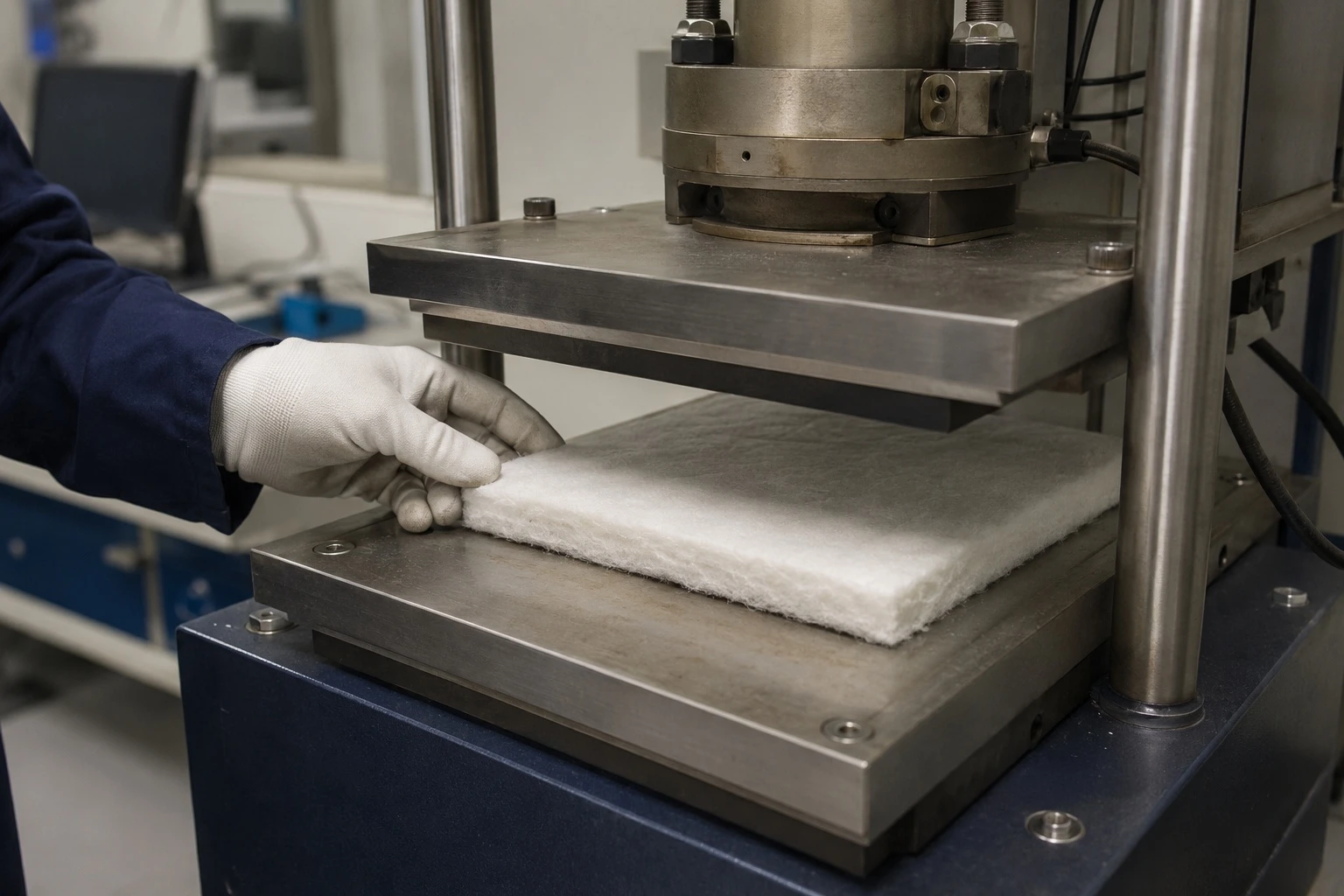
Thermal conductivity is one of the most important specifications when selecting aerogel felt for an industrial insulation project. It directly affects heat loss, insulation thickness, equipment surface temperature and long-term energy consumption.
However, comparing aerogel insulation products based on a single thermal conductivity value can be misleading. Test temperature, product density, thickness, moisture exposure and installation quality can all affect actual thermal performance.
This guide explains how aerogel felt thermal conductivity is measured, why it changes with temperature and what buyers should check before placing an order.
What Is Aerogel Felt?
Aerogel felt, also known as an aerogel blanket, is a flexible insulation material made by combining silica aerogel with a fibrous reinforcement layer.
Silica aerogel has a highly porous nanoscale structure that limits heat transfer through solid conduction, gas movement and convection. The fiber reinforcement makes the otherwise fragile aerogel easier to roll, cut and install around pipes, tanks, valves and industrial equipment.
Compared with many conventional insulation materials, aerogel thermal insulation felt can achieve the required thermal performance with a thinner insulation layer. This makes it especially useful when installation space is limited.
What Does Thermal Conductivity Mean?
Thermal conductivity describes how easily heat passes through a material. It is normally expressed in:
W/(m·K)
A lower value means that the material transfers less heat and therefore provides better insulation at the same thickness.
For example:
A material with a thermal conductivity of 0.020 W/(m·K) provides better insulation than one rated at 0.040 W/(m·K) when both are tested under the same conditions.
If two materials need to achieve the same thermal resistance, the material with lower thermal conductivity can generally use a thinner insulation layer.
Thermal conductivity is commonly represented by the Greek letter λ, or lambda.
Typical Thermal Conductivity of Aerogel Felt
Depending on its formulation, density and operating temperature, industrial silica aerogel felt commonly has a thermal conductivity of approximately:
0.012–0.020 W/(m·K) at or near room temperature
This is a general reference range rather than a guaranteed value for every product.
For example, the website's aerogel blanket thermal insulation is listed with a thermal conductivity of approximately 0.012–0.018 W/(m·K) at 25°C, depending on the selected grade.
Another 10mm aerogel blanket for pipe insulation provides representative conductivity data at different temperatures:
| Mean Temperature | Representative Thermal Conductivity |
|---|---|
| 25°C | 0.020 W/(m·K) |
| 200°C | 0.028 W/(m·K) |
| 300°C | 0.035 W/(m·K) |
| 400°C | 0.044 W/(m·K) |
| 500°C | 0.069 W/(m·K) |
These figures show an important point: the thermal conductivity of aerogel felt is not constant. It generally increases as the mean operating temperature rises.
Buyers should request a complete thermal conductivity curve rather than relying only on the room-temperature value.
Why Does Aerogel Felt Have Low Thermal Conductivity?
Heat can move through insulation in several ways:
Conduction through the solid structure
Conduction through the gas inside the pores
Convection within larger air spaces
Thermal radiation
Aerogel felt reduces these heat-transfer mechanisms through its nanoscale pore structure.
Limited Solid Conduction
Silica aerogel contains a very small amount of solid material compared with its total volume. The complex network also creates a long and indirect path for heat to travel through the solid structure.
Reduced Gas Conduction
The pores inside aerogel are extremely small. This restricts the movement and collision of gas molecules, reducing heat transfer through the air contained within the material.
Suppressed Convection
Because the pores are nanoscale, air cannot circulate freely inside the aerogel structure. This significantly limits convective heat transfer.
Reduced Thermal Radiation
Some high-temperature aerogel formulations include opacifiers or other components designed to reduce radiative heat transfer. This becomes increasingly important as operating temperature rises.
Thermal Conductivity Changes with Temperature
A room-temperature thermal conductivity value does not fully describe how insulation will perform on a hot pipeline or industrial furnace.
As temperature increases:
Gas conduction generally increases
Radiative heat transfer becomes more significant
The effective thermal conductivity of the insulation rises
A greater thickness may be required to achieve the target surface temperature
For this reason, thermal insulation calculations should use the conductivity value at the expected mean temperature, not simply the conductivity at 25°C.
The mean temperature is commonly estimated as:
Tm=Th+Tc2T_m = \frac{T_h + T_c}{2}
Where:
TmT_m = mean temperature
ThT_h = hot-side temperature
TcT_c = cold-side temperature
For a pipe operating at 300°C with an expected insulation outer-surface temperature of 40°C, the approximate mean temperature would be:
Tm=300+402=170∘CT_m = \frac{300 + 40}{2} = 170^\circ C
The thermal conductivity used in the initial calculation should therefore be based on data close to 170°C-not the value measured at room temperature.
A professional thermal calculation may require iterative evaluation because the surface temperature, thermal conductivity and total heat loss influence one another.
Thermal Conductivity vs Thermal Resistance
Thermal conductivity and thermal resistance are related, but they are not the same specification.
Thermal resistance indicates how strongly a particular thickness resists heat flow. For a flat, uniform layer, it can be estimated using:
R=dλR = \frac{d}{\lambda}
Where:
RR = thermal resistance in m²·K/W
dd = insulation thickness in metres
λ\lambda = thermal conductivity in W/(m·K)
For example, a 10mm aerogel felt with a thermal conductivity of 0.020 W/(m·K) would have an approximate thermal resistance of:
R=0.0100.020=0.50 m2\cdotpK/WR = \frac{0.010}{0.020}=0.50\ \text{m}^2\text{·K/W}
If the same material's conductivity rises to 0.028 W/(m·K) at a higher temperature, its calculated resistance becomes:
R=0.0100.028≈0.36 m2\cdotpK/WR = \frac{0.010}{0.028}\approx0.36\ \text{m}^2\text{·K/W}
This simplified example demonstrates why both thickness and operating-temperature conductivity must be considered.
Actual pipe and equipment insulation calculations also need to account for geometry, surface emissivity, ambient conditions, wind speed and outer cladding.
What Affects Aerogel Felt Thermal Conductivity?
1. Operating Temperature
Thermal conductivity usually increases as the mean temperature rises. Always request conductivity data covering the project's actual operating range.
2. Product Density
Density affects the balance between solid conduction and pore structure. A higher-density product is not automatically a better insulator, although it may offer improved mechanical strength.
3. Aerogel Content
Products sold under the general name "aerogel felt" may contain different amounts of silica aerogel. Lower aerogel content can reduce thermal performance, even when the products appear similar.
4. Fiber Reinforcement
The type, structure and density of the reinforcing fibers affect flexibility, mechanical strength and heat transfer through the finished blanket.
5. Moisture Exposure
Water has a much higher thermal conductivity than still air. When conventional fibrous insulation absorbs moisture, its thermal performance can deteriorate significantly.
Hydrophobic aerogel felt helps resist liquid-water penetration. The website's aerogel thermal insulation felt, for example, is listed with a hydrophobic rate of at least 99.6%.
However, hydrophobic does not mean that an entire insulation system is automatically waterproof. Joints, penetrations and external cladding must still be properly sealed.
6. Compression
Excessive compression can change the thickness and internal structure of the blanket. If a nominal 10mm layer is compressed to 7mm during installation, the final thermal resistance will be lower because the installed thickness has been reduced.
The material should be secured firmly without unnecessary crushing.
7. Seams and Gaps
Poorly fitted joints can create thermal bridges and allow heat to bypass the insulation layer. Even a low-conductivity material cannot compensate for large gaps or poorly designed terminations.
Staggered joints are recommended when multiple layers are installed.
Why Thickness Still Matters
Low thermal conductivity does not eliminate the need for sufficient insulation thickness.
Common aerogel felt thicknesses include:
3mm
5mm
6mm
8mm
10mm
Multiple layers can be used when the project requires greater thermal resistance.
The correct thickness depends on:
Equipment operating temperature
Required outer-surface temperature
Allowable heat loss
Pipe or equipment dimensions
Ambient temperature
Indoor or outdoor installation
Wind speed
External cladding
Personnel-protection requirements
Available installation space
Aerogel felt is particularly valuable where thick conventional insulation cannot be installed because of limited clearance, closely spaced pipelines or restricted equipment access.

Aerogel Felt vs Conventional Insulation
The following values are general reference ranges at or near room temperature. Actual values vary by product grade and test conditions.
| Insulation Material | Typical Thermal Conductivity |
|---|---|
| Aerogel felt | 0.012–0.020 W/(m·K) |
| Mineral wool | 0.034–0.045 W/(m·K) |
| Fiberglass insulation | 0.032–0.045 W/(m·K) |
| Calcium silicate | 0.050–0.070 W/(m·K) |
| Ceramic fiber blanket | Approximately 0.035–0.060 W/(m·K), depending strongly on temperature and density |
The comparison does not mean aerogel is the best choice for every project. Traditional materials may provide a lower initial material cost and can be suitable where there is enough installation space.
Aerogel felt is often considered when a project requires:
Reduced insulation thickness
Lower heat loss within limited space
Good resistance to moisture
Easier installation around complex shapes
Reduced insulation volume
Performance across a wide temperature range
Common Industrial Applications
High-Temperature Pipelines
Aerogel felt can be wrapped around steam, process and petrochemical pipelines. Its low conductivity helps control heat loss without requiring an excessively thick insulation layer.
Oil and Gas Facilities
It is used for pipelines, vessels and processing equipment where space, weather exposure and corrosion under insulation are important concerns.
LNG and Cryogenic Systems
Suitable grades can be considered for low-temperature pipelines and equipment. The material selection must be based on the specified minimum operating temperature and system design.
Power Generation
Aerogel insulation can be applied to turbines, boilers, steam systems and other equipment where energy efficiency and surface-temperature control are required.
Industrial Tanks and Vessels
Flexible blankets can conform to curved surfaces and complex equipment profiles more easily than some rigid insulation products.
Marine and Offshore Equipment
Limited installation space and moisture exposure make low-conductivity, hydrophobic insulation attractive for certain shipboard and offshore applications.
How to Compare Thermal Conductivity Data
When reviewing supplier data sheets, check whether the values were measured under comparable conditions.
Ask the supplier to confirm:
Test standard
Mean test temperature
Product thickness
Product density
Measurement direction
Sample conditioning
Moisture condition
Test laboratory or report source
Conductivity tolerance
Whether the figures are typical or guaranteed values
Two suppliers may state different conductivity values because one reports performance at 25°C while another uses a higher mean temperature. The lower number is not necessarily evidence of a better product unless the test conditions are equivalent.
Information to Provide When Requesting a Quotation
To receive an appropriate product recommendation, buyers should provide:
Intended application
Normal operating temperature
Maximum and minimum temperatures
Pipe diameter or equipment dimensions
Required surface temperature
Maximum permitted heat loss
Available insulation space
Indoor or outdoor environment
Exposure to rain, chemicals or mechanical damage
Required thickness
Roll width and order quantity
Fire-performance requirements
Required test standards
Cladding or jacketing method
The complete aerogel felt product range can include different thicknesses, densities and temperature grades. Final selection should be based on the project conditions rather than on the lowest room-temperature conductivity value alone.
Frequently Asked Questions
What is a good thermal conductivity value for aerogel felt?
Many industrial aerogel felt products have a thermal conductivity of approximately 0.012–0.020 W/(m·K) at or near room temperature. The actual value depends on the product grade and test conditions.
Does aerogel felt conductivity increase at high temperatures?
Yes. Effective thermal conductivity generally increases with temperature. Buyers should request values at several mean temperatures covering the intended operating range.
Is thicker aerogel felt always better?
A thicker layer provides greater thermal resistance when the material and operating conditions remain the same. However, the optimal thickness should be determined through thermal calculations, installation limitations and project cost.
Can aerogel felt get wet?
Hydrophobic aerogel felt resists liquid-water penetration, but seams, damaged cladding and unsealed penetrations may still allow moisture into the insulation system. Proper weather protection remains necessary.
Can two layers of aerogel felt be installed?
Yes. Multiple layers are commonly used to achieve the required thickness. Joints should be staggered to reduce direct heat paths and improve overall insulation continuity.
Is the lowest conductivity product always the best choice?
Not necessarily. Buyers should also evaluate temperature range, mechanical strength, hydrophobic performance, fire classification, dimensional tolerances and installation requirements.
Conclusion
Aerogel felt offers very low thermal conductivity and can deliver high insulation performance with less thickness than many conventional materials. However, room-temperature conductivity alone is not enough to select the correct product.
Buyers should compare conductivity values at the project's actual mean temperature, confirm the test method and consider installed thickness, moisture exposure, compression and joint design.
By providing complete operating conditions and requesting reliable technical data, buyers can select an aerogel felt that achieves the required balance of thermal efficiency, installation thickness, durability and project cost.


